
Many people are familiar with the name "creatine" as a sports supplement, but in reality, our brains depend heavily on creatine, just like our muscles, especially during periods of mental fatigue, strenuous brain use, lack of sleep, or prolonged stress. New research suggests that creatine may significantly boost brain energy, memory, concentration, thinking speed, and reduce brain fog, particularly in older adults and working-age individuals.
Although our brain is small compared to the rest of our body, it is an organ that constantly uses a very high amount of energy. Nerve cells require “cellular energy” (also known as…) ATP) It works constantly so that we can think, remember, manage information, and respond to our surroundings immediately. Even when our body is at rest, the brain still has to work hard, so it relies on a reserve energy system. Creatine-Phosphate System To help provide sufficient energy when needed quickly.
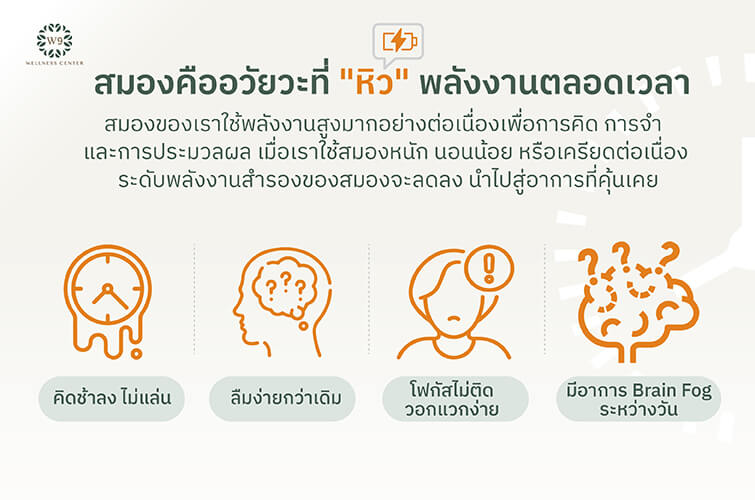
As we age or face ongoing stress, creatine levels in the body and brain decrease, leading many to experience familiar symptoms such as:
This mechanism explains why creatine plays a more significant role than previously thought in "brain energy."
One of the strongest pieces of evidence is a group of genetic disorders that cause low creatine levels in the brain, such as: Creatine Transporter Deficiency, AGAT deficiency and GAMT deficiency Patients in this group have developmental delays, intellectual disabilities, seizures, or autistic-like behaviors, and show improvement when receiving high doses of creatine over a long period of time. This confirms our belief that creatine is indeed an essential substance for brain function.
In older adults, a review of six studies found that creatine helps...
Even scores from a brain screening test called... Mini-Mental State Examination (MMSE) The changes won't be drastic, but my brain function in daily life has clearly improved.
A randomized controlled trial found that... The size used has a significant impact.
Research using specialized brain scans to directly measure creatine levels has found that for creatine levels in the brain to truly increase, relatively high doses are usually required continuously for about 4 weeks or more. And even a slight increase of around 3–10% is enough to improve certain brain functions in some people.
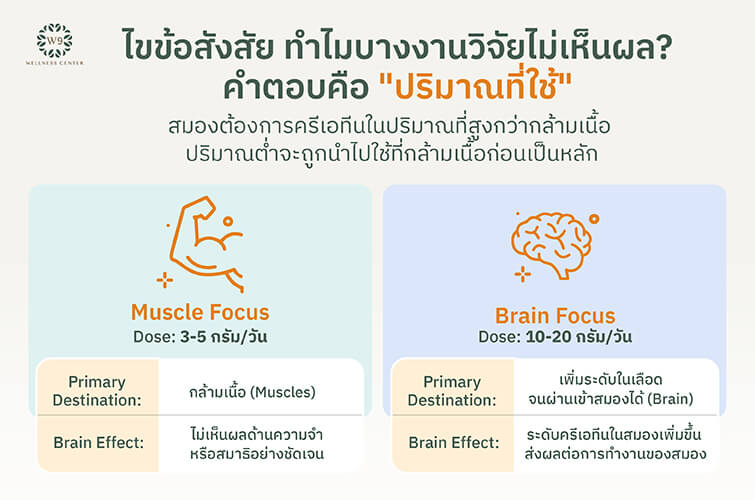
The key difference lies in the "dosage used," because the brain requires much more creatine than muscles. Supplementing with only 3–5 grams per day, the amount most people use, will result in the creatine being stored in the muscles first. This means that blood creatine levels won't be high enough to significantly cross into the brain, so significant improvements in memory or concentration are often not seen.
Conversely, research using larger doses, such as 10–20 grams per day for several weeks, has shown that creatine levels in the brain do increase, albeit not significantly, but enough to affect processing and memory in some individuals.
Creatine isn't for everyone, but several groups may benefit particularly, including:
Although there are many types of creatine on the market, in terms of medical evidence... Creatine Monohydrate It is the most studied and accepted format.
For other forms of creatine, such as Creatine HCL or Buffered Creatine, which are often promoted as having better absorption, there is currently no clear medical evidence that they are more effective than the standard form. Creatine Monohydrate In terms of effects on the brain or body.
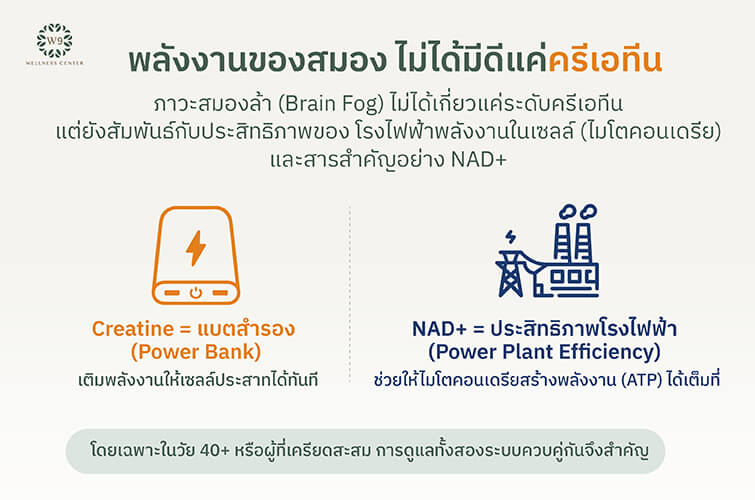
Brain fog isn't just about creatine levels in the brain; it's also related to performance... mitochondria And important substances such as... NAD+ This decrease is significant with age or accumulated stress.
Therefore, adjusting brain energy often requires considering both systems together, especially in those with brain fog, sleep deprivation, or those over 40.
With the goal of maximizing "brain energy" rather than muscle, many studies suggest that the dosage should be slightly higher than normal.
The response time to creatine varies from person to person, but overall it was found that:
To ensure creatine is absorbed and works effectively, it is recommended to...
Most research has not found that creatine causes kidney damage or leads to abnormally high creatinine levels.
Therefore, if you have any risk factors, it is always recommended to consult a doctor before starting to use this product.
While creatine can help boost brain power, a comprehensive health assessment is always important, and a doctor may recommend it.
And may choose to use related therapies such as: NAD+ Therapy, Brain Booster IV or HBOT It depends on each person's situation.
Creatine plays a role not only in muscle function but also supports brain energy during periods of fatigue, such as lack of sleep, stress, or jet lag. Several studies have found that it may help with memory, attention, and thinking speed, with the results often being more pronounced in older adults and those experiencing brain fog.
Brain-related effects require higher doses than those used for muscle growth. Generally, around 10–20 grams per day over several weeks is needed to see changes. However, the appropriate dosage depends on the individual, and it's advisable to consult a healthcare professional before supplementing.
For those seeking to support brain energy, creatine may be an interesting option, but it should be considered in conjunction with sleep habits, stress management, nutrition, and a holistic health assessment for optimal results.
This article is for educational purposes only and is not intended to provide advice on the prevention or treatment of any disease. Readers are not advised to self-medicate. Consult a doctor or healthcare professional for further appropriate advice.
Rama IX Hospital (3rd floor, Building A)
Written and compiled by

Dr. Chalermpon Innachit (Dr. Nong)
Anti-aging and preventative medicine physician
W9 Wellness Center
Further references
● Ostojic SM, Korovljev D, Stajer V. Dietary creatine and cognitive function in US adults aged 60 years and over. Aging Clin Exp Res. 2021 Dec;33(12):3269-3274.
● Candow DG, Forbes SC, Ostojic SM, Prokopidis K, Stock MS, Harmon KK, Faulkner P. “Heads Up” for Creatine Supplementation and its Potential Applications for Brain Health and Function. Sports Med. 2023 Dec;53(Suppl 1):49-65.
● Avgerinos KI, Spyrou N, Bougioukas KI, Kapogiannis D. Effects of creatine supplementation on cognitive function of healthy individuals: A systematic review of randomized controlled trials. Exp Gerontol. 2018 Jul 15;108:166-173.
● Xu C, Bi S, Zhang W, Luo L. The effects of creatine supplementation on cognitive function in adults: a systematic review and meta-analysis. Front Nutr. 2024 Jul 12;11:1424972.
● Stockler S, Schutz PW, Salomons GS. Cerebral creatine deficiency syndromes: clinical aspects, treatment and pathophysiology. Subcell Biochem. 2007;46:149-66.