Even if we get enough sleep, eat well and exercise regularly, many people still feel “not as energetic” or “unexplained brain fatigue.” One important factor that is often overlooked is the level of NAD+ (Nicotinamide Adenine Dinucleotide) It is an important biomolecule in every cell of the body and tends to decrease with age.
What is NAD+ and how does it work in the body?
NAD+ It is a coenzyme found in every human cell and plays an important role in converting energy from food into usable energy for cells in the form of: ATP (Adenosine Triphosphate) It is also a precursor to DNA components. When NAD+ levels are low, energy production and cellular repair processes are impaired, which can be associated with fatigue, cognitive decline, and signs of cellular aging.
NAD+ is also involved in
- Gene activation Sirtuins which plays a role in the process of slowing down degeneration and controlling inflammation
- Repair DNA and maintaining gene stability
- Nervous system function and intercellular signaling
- Energy metabolism and metabolic balance
Read more
- Nature Reviews Molecular Cell Biology : NAD+ metabolism and its roles in aging
- PubMed: Lautrup, 2024 : Roles of NAD+ in Health and Aging
- Mayo Clinic News Network : CD38 linked to age-related NAD+ decline
Key mechanisms of NAD+
Think of NAD+ as an “energy bridge” connecting the food we eat to the energy our cells actually use (ATP). When this bridge weakens, cells produce less energy, the brain may become fatigued, and repair systems slow down. But when NAD+ levels are balanced, cellular mechanisms return to functioning efficiently, including gene function. Sirtuins (SIRT1–SIRT7) Which is related to the flexibility of cell age, it will also work more balanced.
note: Some evidence comes from mechanistic and animal studies, such as: Harvard Medical School “Rewinding the clock” which still needs further human studies to confirm its effectiveness directly
Factors that cause NAD+ levels in the body to decrease
level NAD+ It can be changed by many factors. A review of human studies found the following associations:
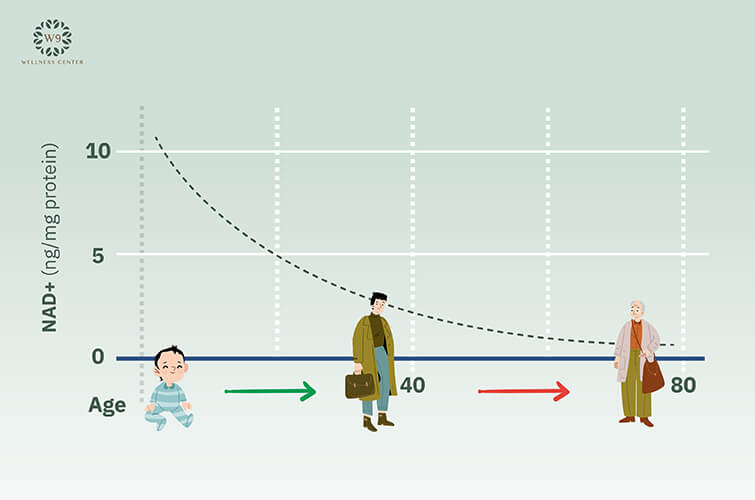
- Increasing age & elevated CD38 enzyme: The activity of NAD+ degrading enzymes (such as CD38) tends to increase with age, altering the NAD+/NADH ratio and affecting cellular energy production.
- DNA damage & overactivation of PARP:When DNA damage occurs due to oxidative stress/UV radiation/inflammation, the PARP enzyme uses NAD+ as a substrate, and NAD+ levels may decrease rapidly.
- Chronic inflammation/metabolic disorders:Obesity/fatty liver and low-grade inflammation are associated with NAD+ depletion via immune pathways and NAD+-degrading enzymes.
- Nutrition/Behavior: Inadequate intake of precursors of the synthetic pathway (e.g., niacin/tryptophan), excessive alcohol consumption (skews the NAD+/NADH ratio), and sleep disruption from the circadian clock (affecting the NAMPT enzyme) have all been associated with NAD+ levels.
4 Important Systems in Which NAD+ Frequently Plays a Role in the Body
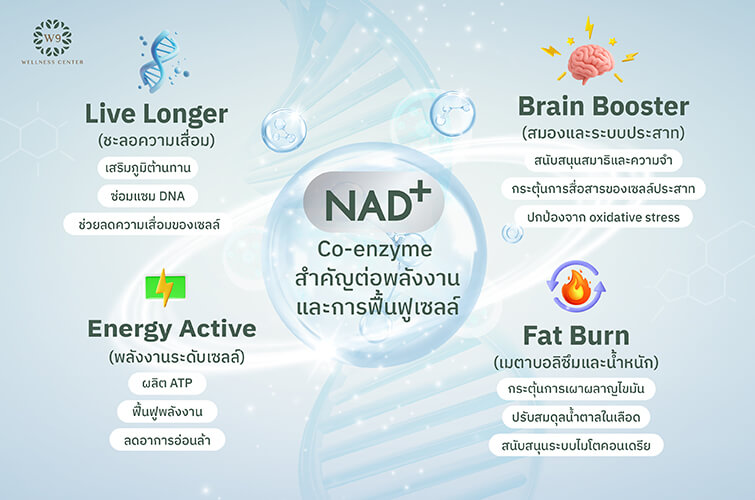
Boost energy and metabolism
NAD+ works with enzymes in mitochondria to create ATP energy. When NAD+ levels are optimal, the body can produce energy more efficiently and may help you feel more energetic throughout your day, especially in those with high energy needs.
Supports the brain and nervous system
NAD+ is a major energy source for neurons and is involved in memory and brain function. Harvard Medical School (2020) Increasing NAD+ in the blood vessels of aged animal models has been reported to restore brain circulation and support neuronal health.
Balance metabolism and control weight
NAD+ is involved in fat metabolism (β-oxidation) and blood glucose homeostasis. Work from Nature Portfolio (2023) It has been shown that NAD+ supplementation may contribute to improving mitochondrial performance in people over 40.
What is the difference between NAD+, NMN, and NR?
- NAD+ is the actual coenzyme used by cells.
- NMN (Nicotinamide Mononucleotide) and NR (Nicotinamide Riboside) are precursors that the body must convert to NAD+ before it can be used.
- IV NAD+ therapy increases levels more directly and rapidly than oral NAD+ (mechanically).
Comparing NR/NMN Supplements vs NAD+ IV Therapy
| Issue | NR/NMN (Dietary Supplement) | NAD+ IV Therapy |
| type | Eat at home | Intravenous fluids in the clinic |
| mechanism | Precursor converted to NAD+ | It is NAD+ directly into the bloodstream. |
| The speed at which feelings change | Take it slowly and eat it regularly. | It is generally faster because it is given directly. |
| Scaling/Formula | Fixed according to product label | The dosage can be adjusted by a doctor according to your physical condition. |
| Tracking | Users mainly follow themselves. | There is an assessment and follow-up by a doctor/nursing team. |
*Results vary from person to person. Human evidence is still evolving.
• Reference overview mechanism: Nature Reviews Mol Cell Biol : https://www.nature.com/articles/s41580-020-00313-x | PubMed (Xie 2020) : https://pubmed.ncbi.nlm.nih.gov/33028824/
Safety, Limitations, and Precautions of NAD+ IV Therapy
Overall safety
Intravenous NAD+ administration should be performed in a standardized medical facility under the supervision of a physician and professional nurse, with pre-treatment health screening and monitoring during administration.
Possible adverse effects (usually temporary, mild)
- Feeling hot or flushed
- Nausea, dizziness, or mild headache
- Chest tightness, discomfort (improved when the infusion rate is adjusted)
- Irritation in the area where the substance is administered
Groups that should consult a doctor before receiving treatment
- Heart disease, blood vessels, liver disease, kidney disease
- Pregnant or breastfeeding
- Have a history of allergic reactions to certain medications and vitamins
- Use multiple medications or dietary supplements
Tips before receiving treatment
- Get enough rest
- Drink 1–2 glasses of water before doing it.
- Inform your doctor about your regular medications, dietary supplements, or herbs.
- After the procedure, you should drink water and avoid strenuous activity on the same day.
Results that clients often observe
- Feel refreshed and more energetic
- Clearer mind and better concentration
- Sleep deeply and wake up refreshed.
- Skin looks lively
- Recover quickly after exercise or hard work
Results vary from person to person, depending on physical condition and doctor's assessment.
NAD+ trends in Thailand
- In the past few years Interest in preventive and anti-aging medicine is increasing. Especially in the working age group who want to take care of their health in depth before disease occurs.
- The appropriate approach is Should be under the care of a doctor Have a health check before receiving treatment and continuously monitor symptoms every time for safety and optimal results.
- Before deciding Service recipients should consider the clinic's standards. The source of the substances used, including the post-treatment follow-up system
- Therapy with NAD+ will be more effective When combined with proper nutrition, quality sleep, proper exercise, and daily stress management,
Holistic care experience at W9 Wellness
All treatments NAD+ at W9 Wellness Center is administered by professionally trained nurses. Under Supervision and care by a physician specializing in anti-aging medicine. Before receiving treatment, the service recipient will receive: Evaluate and consult with a doctor To provide guidelines that are appropriate for each individual's health and goals.
Let W9 Wellness be a part of your compassionate care by restoring balance from the inside out to the cellular level, leaving you feeling energized, refreshed, and ready to live life with confidence once again.
Frequently Asked Questions (FAQ)
Q: Is NAD+ IV safe?
A: Safe when under the care of professional doctors and nurses.
Q: How should I prepare before doing NAD+ IV?
A: Get enough rest, drink plenty of water, and inform your health history before receiving the service.
Q: How often should I do this?
A: It is generally recommended 1–2 times per month, or consult your doctor based on your health goals.
Q: Can this be used in conjunction with Vitamin IV Drip?
A: They are often used together to support energy and restore overall health.
Q: Why do NAD+ levels decrease with age?
A: Reviews suggest that it is related to increased NAD+ degrading enzymes (such as CD38), PARP activation from DNA damage, and certain lifestyle factors such as irregular sleep, nutrition, and alcohol. The effects vary from person to person.
Primary references
- Nature Reviews Molecular Cell Biology – NAD+ metabolism and its roles in cellular processes during aging
- Harvard Medical School – Rewinding the Clock (Animal Study)
- Mayo Clinic News Network – CD38 linked to age-related NAD+ decline
- PubMed (Lautrup, 2024) – Roles of NAD+ in Health and Aging
- PubMed (Xie, 2020) – NAD+ metabolism: mechanisms and therapeutic potential