Over the past decade, the concept of "longevity" has expanded at an unprecedented pace. People have become increasingly interested in anti-aging, from comprehensive health checkups and supplements to new forms of exercise and even calorie restriction and secret formulas claiming to extend lifespan. This interest reflects a genuine human desire to live longer and healthier lives. However, this rapidly growing trend has also brought about... Misconceptions about Longevity Widely disseminated information, including misconceptions, false beliefs, and seemingly applicable advice, often leads many to neglect their health inappropriately or choose methods unsuitable for their bodies.
Preventive healthcare and anti-aging (Longevity & Preventive Medicine)
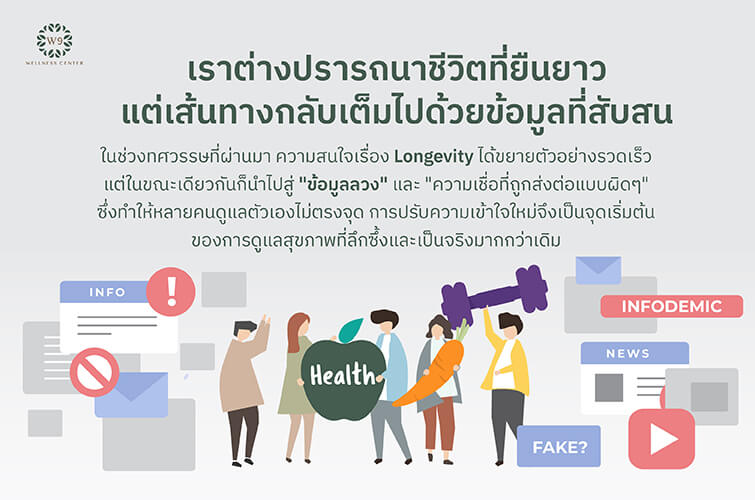
Understanding Misconceptions about Longevity Therefore, it's not just about information, but the starting point for a gentler, deeper, and more realistic approach to healthcare.
This article will take you on a deep and clear exploration, point by point, to reveal the truth confirmed by research, and to view longevity in a way that is "realistic" and "suitable for real human life," not just an image of perfection created through media or a temporary trend.
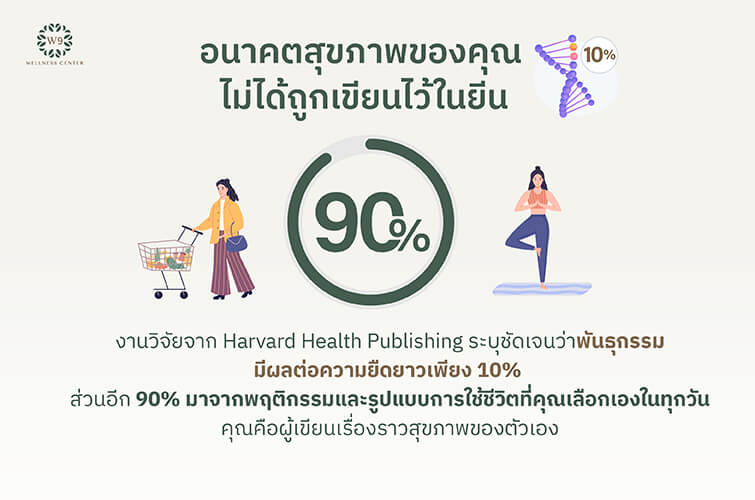
One of the most common misconceptions about longevity is the belief that "lifespan is determined by genes," as if if your family has a history of longevity, you will automatically live that long, or if your family has a short lifespan, you are tied to your destiny. Research from... Harvard Health Publishing It is clearly stated that genetics only plays a minor role. 10% Of all the longevity studies (Harvard Health Publishing – Longevity & Genetics), data from twin studies and analyses of large populations worldwide support the same conclusion that: The 90% longevity trait comes from the behaviors and lifestyles we create for ourselves.
When viewed this way, our lives are not limited by genetics as one might think, but are open to us to create them ourselves every day.
Many people believe that physical decline is "inevitable" and "accelerates with age," but that's not always the case.
The brain and body do change with age, however... Deterioration rate What we can control is more important than the work of others. National Institute on Aging The National Institute for Aging Research (NIA) concludes that cellular degeneration, such as mitochondrial damage and decreased cellular function, occurs at a rate that depends on the things we repeat every day.
Accelerators of aging are often things that happen unnoticed, such as:
Conversely, behaviors that help slow down aging are simple yet powerful, including:
Therefore, decline is not something to be left to chance, but rather a process we can adapt to, if we understand the structure of our own health.
Another increasingly common misconception is the belief that intense exercise (such as daily HIIT or lifting very heavy weights) is the only effective way to achieve longevity. However, the actual evidence points in the opposite direction. Reports indicate... Cleveland Clinic In conclusion, Frequency of movement "The intensity of exercise has a greater impact on heart health and longevity" (Cleveland Clinic – Movement & Longevity). Data from community studies in Blue Zones also indicate that the world's longest-living people don't have a culture of strenuous exercise, but rather live lives full of natural movement.
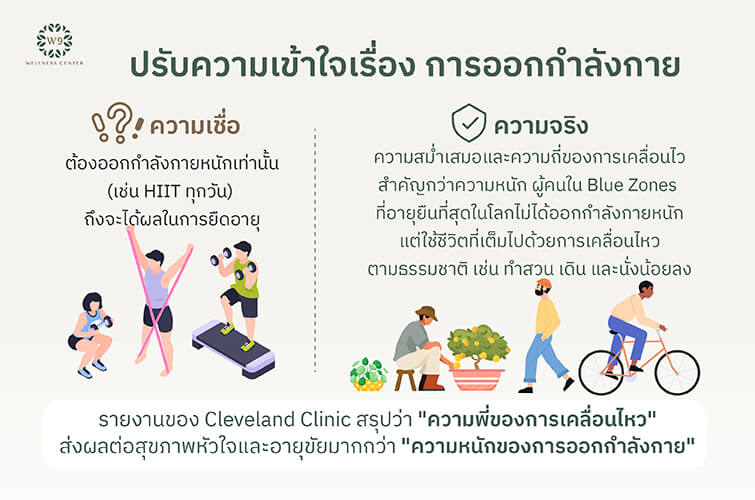
Movements that promote longevity typically have the following characteristics:
Longevity views the importance of encouraging physical activity by "moving more but not stressing too much."
The dietary supplement industry has grown so rapidly that many people believe "the more you eat, the better" or "supplements can directly extend your lifespan." But a report by... Mayo Clinic It is stated that there is no conclusive evidence that any dietary supplement can significantly increase human lifespan (Mayo Clinic – Supplements & Longevity).
The true role of dietary supplements is...
And most importantly... Dietary supplements cannot replace basic health. For example, good sleep, good eating, and physical activity are important. To maximize the benefits of supplements, they should be used with a correct understanding and supported by your own information, such as checking your levels of vitamins, minerals, immunity, or hormones.
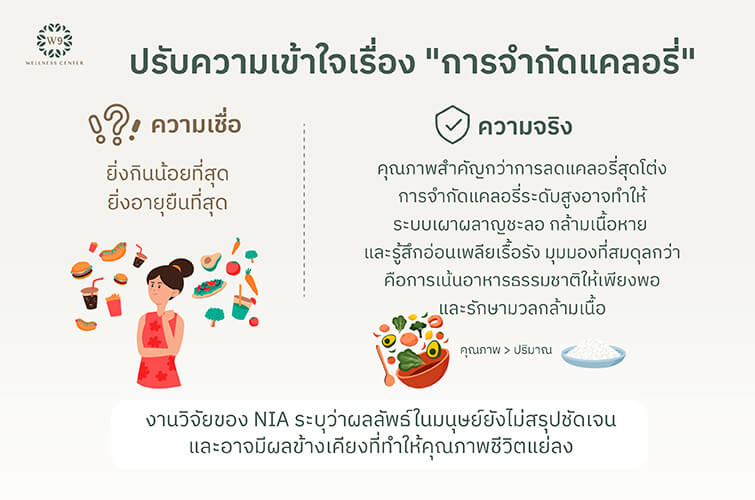
One widely shared misconception about longevity is the idea that "eating as little as possible maximizes lifespan." Some animal studies support this idea, but the results in humans are not always the same.
Research by NIA It has been stated that high levels of caloric restriction may slow metabolism, cause muscle loss, dangerously low blood pressure, and chronic fatigue (NIA – Calorie Restriction Review). These side effects can impair quality of life, even though the goal is improved health.
A more balanced perspective is:
The appropriate amount of food is therefore a personal matter; there is no one-size-fits-all answer.
Another common misconception is that older adults “need less sleep,” even though their work requires it. Harvard Health It is stated that older adults still need about 6–7 hours of deep sleep per night to help the brain and various systems within the body recover (Harvard Health – Sleep & Aging).
Poor sleep quality is associated with...
Some older adults may have difficulty sleeping due to changes in their nervous and hormonal systems, but this doesn't mean their bodies need less sleep. Establishing a bedtime routine, adjusting the room environment, and managing stress are important for all ages, especially for older adults.
even Blue Zones While the accuracy of the data may be criticized in some areas, the overarching principle remains extremely useful. Studies have found that people in areas with the longest life expectancy tend to share common lifestyles, such as:
These patterns are not a "secret formula," but rather the cumulative result of consistently living a balanced life in many aspects.
Many misconceptions about longevity stem from applying general advice to everyone, when each person's body is fundamentally different, from hormone levels and inflammation to metabolism, microbiome, and even psychological needs.

Intensive health check-ups, such as:
It helps reveal the "true picture" of each person's health, making Longevity care personalized and accurate, not guesswork.
People who understand their own bodies at a deep level tend to take better care of their health because they "care for themselves in a way that truly suits them," without forcing themselves, overdoing it, or following trends that don't suit them.
When we view longevity through the lens of medical evidence, many misconceptions gradually dispel. We see that longevity doesn't come from achieving great things, but from simple things done repeatedly every day: good sleep, good nutrition, regular movement, mental relaxation, and understanding the body's true needs.
Longevity isn't about "living as long as possible," but about "living well every year of your life." And when understanding is correct, care becomes easier, gentler, and truly in harmony with our nature.
1) How much influence do genetics have on life expectancy?
Research has found that genetics plays only about 10%; the majority of longevity comes from daily habits such as sleep, diet, movement, and stress management.
2) Do I need to exercise intensely to help slow down aging?
Not necessarily. Regular movement throughout the day, such as walking, getting up and changing posture, or doing housework, is more beneficial for metabolism and cardiovascular health than even short bursts of strenuous exercise.
3) Do dietary supplements really increase lifespan?
There is no conclusive evidence that dietary supplements directly "extend lifespan," but they can be beneficial for individuals deficient in certain nutrients. They should be used under the guidance of a physician and based on conclusive test results.
4) Does calorie restriction help you live longer?
Human data is inconclusive, and excessive calorie restriction may disrupt muscle and hormone balance. A safe approach is to eat natural foods in moderate amounts and listen to your body.
5) Should older adults really sleep less?
That's not true. Older adults still need about 6–7 hours of deep sleep. Insufficient or shallow sleep increases the risk of chronic diseases and leads to memory loss.
6) How can you tell if your body is aging too quickly?
This can be assessed through in-depth examinations of areas such as biological age, hormones, inflammation, microbiome, and metabolism, helping to identify the root cause and design more personalized care.
7) If you want to start taking care of your longevity, where should you begin?
Start with the basics you can do every day: get enough sleep, increase walking, reduce inflammation, and manage stress. Then, build upon this with personalized health checkups to create a plan that best suits your body.
Praram 9 Hospital (3rd floor, Building A)
Written and compiled by

Anti-aging and preventative medicine physician
W9 Wellness Center