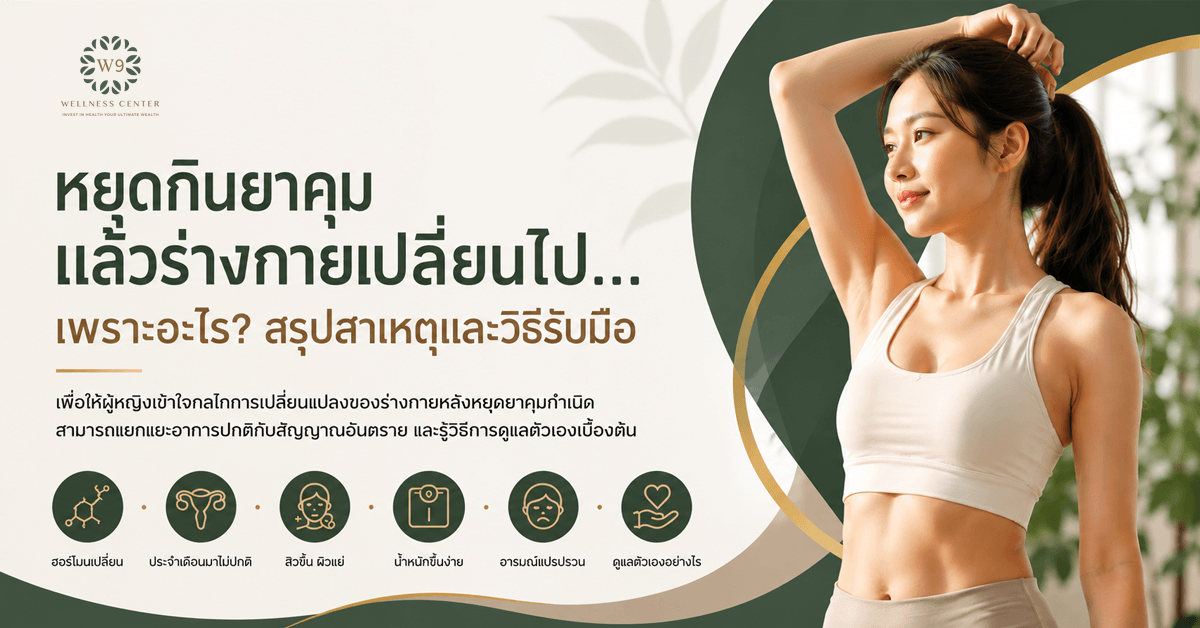
Many women notice changes in their bodies after stopping birth control pills, even though their lifestyle remains largely the same. Some experience a return of acne, while others feel tired, have difficulty sleeping, experience mood swings, or have irregular periods. This leads many to search for answers such as, "Does stopping birth control pills disrupt hormone levels?" or "Why does my body change after stopping birth control pills?"
Especially for working adults who face stress, late nights, caffeine, fast food, and a city lifestyle, each person's body may respond to hormonal changes differently.
In preventive medicine, minor changes in menstruation, skin, energy, or mood may be one of the "early signs" reflecting some kind of imbalance in the body before developing into more apparent chronic health problems in the future.
However, for most women, the hormonal system can return to its natural balance after stopping the medication, and there are no long-term side effects.
Hormonal birth control pills are a highly effective method of contraception and are also used to help manage various problems such as acne, irregular periods, or menstrual cramps.

For many women, birth control pills can be safe and significantly improve their quality of life when used under medical supervision.
Mechanistically, hormonal birth control temporarily suppresses the hypothalamic-pituitary-ovarian (HPO) axis to reduce ovulation and regulate the hormonal cycle.
When birth control pills are stopped, the body needs to readjust its natural hormonal cycle. During this transition period, some women may begin to notice certain symptoms more clearly.
In many cases, what is happening may not be a “new abnormality,” but an underlying condition that was previously controlled or suppressed, such as:
This is why women with similar symptoms may have different underlying causes.
Many people still think that sex hormones are only involved in the menstrual cycle, but in reality, hormones are linked to many systems in the body, such as:
Because the hormonal system works as a interconnected network, a change at just one point can affect multiple systems simultaneously.

Some women may begin to notice that their bodies are responding differently to daily life, even if their work, rest, or overall routines remain largely the same.
Some symptoms that women may notice after using or stopping birth control pills include:
These symptoms may be related to several factors, such as:
Meanwhile, preliminary studies are exploring the relationship between gut health and gut health. microbiome And regarding inflammation and the hormonal system, however, this is currently considered emerging evidence and requires further study.
Therefore, the interpretation of symptoms should be viewed in the context of overall health, rather than concluding that they are caused solely by "hormones" or "birth control pills."
One mechanism discussed in research on birth control pills is the increase in SHBG (Sex Hormone-Binding Globulin), a protein that binds to sex hormones, particularly testosterone.

When SHBG levels rise, the level of free hormone available for the body may decrease in some individuals. Therefore, studies have found a correlation with...
However, the research results are inconsistent, and a clear causal relationship has not yet been established.
SHBG may therefore be "one factor" that helps explain some of the bodily changes, rather than being a complete explanation of symptoms after stopping birth control pills.
The term Post-Birth Control Syndrome (PBCS) is often used in the fields of Functional and Integrative Medicine to describe a group of symptoms that some women experience within approximately 4–6 months after stopping hormonal birth control pills.
Commonly mentioned symptoms include:
Currently, PBCS is not an official diagnosis, and the scientific evidence is still under further study.
Therefore, describing symptoms after stopping birth control pills should be done carefully and always take into account each individual's underlying factors.
Some women may start to notice irregular periods, a return of acne, or feel more tired than usual, while others may find themselves more sensitive to stress or experience changes in their sleep quality.
In some cases, there may be accompanying symptoms such as insomnia, hot flashes, fatigue, or changes in the menstrual cycle. These symptoms may be related to both natural hormonal changes and the perimenopause period in women aged 35–45.
One of the key characteristics of perimenopause is menstrual cycle variability, along with changes in hormones such as FSH and estradiol, which may fluctuate over time.
In some individuals, birth control pills may make it more difficult to monitor natural hormonal changes because synthetic hormones can suppress the natural hormonal cycle.
Differentiating between perimenopause, the underlying condition, and the effects of the adjustment period after medication discontinuation may require considering age, menstrual history, test results, and overall health context.

In preventive medicine, assessing hormonal health may not only look at estrogen or progesterone levels, but also consider the relationship between...
In some cases, in-depth testing may help to understand the relationship between symptoms and various body systems more clearly, especially when symptoms are chronic even when basic test results are normal.
Those who wish to undergo a more in-depth assessment may want to read the related information.
Basic guidelines commonly recommended in the field of Preventive Wellness include:

In many people, ovulation may return within 1–3 months after stopping the medication, but in some individuals, it may take longer to regain regular menstrual cycles.
Many people may gradually improve within 3–6 months after stopping birth control pills, but if symptoms persist or affect quality of life, further evaluation by a doctor may help to understand the underlying cause more clearly.
Common symptoms searched for after stopping birth control pills include:
In some cases, these symptoms may reflect an underlying condition such as PCOS, insulin resistance, thyroid disorder, or premenopause.
If symptoms persist or affect quality of life, further evaluation by a doctor may help to understand the underlying cause more clearly.
You should consult a doctor if you experience symptoms such as:
In some cases, your doctor may consider further evaluation, such as of hormones, thyroid function, metabolism, or certain nutritional deficiencies.
Q: My period hasn't come after I stopped taking birth control pills. Is this abnormal?
A: In some people, it may take several months for the body to return to its natural hormonal cycle, especially after using birth control pills continuously for a long time. However, if your period is absent for more than 3 months, you should consult a doctor to evaluate for other possible causes.
Q: What causes acne after stopping birth control pills?
A: Acne after stopping birth control pills may be related to changes in androgen, metabolism, insulin, and inflammation, as well as underlying conditions such as PCOS that were previously controlled while using the medication.
Q: Does stopping birth control pills cause hormonal imbalances?
A: In most women, hormonal systems gradually return to their natural balance after stopping medication, but some symptoms may occur temporarily during the adjustment period, especially when other factors are involved, such as stress, sleep issues, or pre-existing conditions.
Q: After stopping birth control pills, when will ovulation resume?
A: In many people, ovulation may return within 1–3 months after stopping the medication, but in some individuals, it may take longer to regain regular menstrual cycles.
Q: Is Post-Birth Control Syndrome a disease?
A: Currently, PBCS is not an official diagnosis, but a term used to describe a group of symptoms some women experience after stopping birth control pills, such as irregular periods, acne, or mood swings.
Q: How should women aged 35+ differentiate symptoms from perimenopause?
A: Certain symptoms, such as insomnia, fatigue, or changes in menstrual cycles, may be related to both perimenopause and hormonal changes after stopping birth control pills. Assessment should consider age, health history, and additional test results.
Sometimes, seemingly minor symptoms may reflect changes in hormonal balance, sleep patterns, stress, or metabolism that warrant further evaluation.
If you start noticing changes in your body, even if your basic tests are normal, a more in-depth evaluation can help you better understand the relationship between hormones, stress, sleep, and metabolism.
W9 Wellness Center has two branches.
📍Rama 9 Branch (Ital-Thai House Building)
Call 062-424-2298
📍Chaengwattana Branch (Charn Avenue Project)
Call 062-424-9429
Line @w9bkkwellness